MPE polysynth · plays in your browser
Sylvaris
A generative forest synthesizer. Thirty-two voices of MPE grown from the Mutable Instruments lineage — playable right here.

not started
Want the real thing? The private macOS beta is running — apply for a slot, or read the beta quick-start first.
On iPad? The iPad beta is open on TestFlight.
Beyond the demo
The rest of the instrument
Sylvaris is a thirty-two-voice MPE polysynth grown from the Mutable Instruments lineage — Plaits, Rings, Warps, Clouds, Tides, Marbles, Stages and Elements, rebuilt as one instrument rather than a rack of modules. Every voice is a physical event: an oscillator or an exciter driving a resonant body, folded, filtered, and blown through granular mist — and a 207-destination modulation web lets any part of the forest move any other. It plays itself as much as you play it: SEEDS germinates patterns, SEASONS turns them through the year, and the pond turns touch into music. Less a control panel, more a place.
What you just played is the full per-voice chain — ROOTS into HOLLOWS, shaped by FILTER and ENV — with the SEEDS arp on top. Here is the rest of the instrument. (Not pictured: the header's dice, which rerolls every sound-shaping knob in one tap with a one-step undo; A/B compare; PLAY mode; and the MIDI modes — MPE, poly, multi, mono and legato with glide.)
- Performance What you played in the demo.
-
MACROS
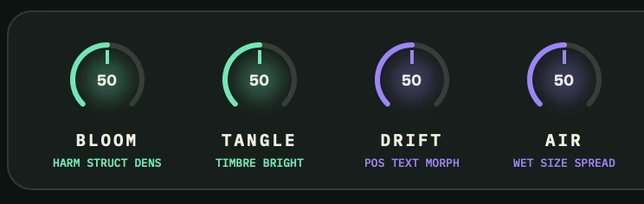
Four macros sit under the pond, offsetting whatever patch is loaded rather than replacing it — neutral at 50, so a preset sounds exactly as designed until you turn one. BLOOM opens harmonics, structure and density; TANGLE hardens timbre and brightness; DRIFT slides grain position, texture and morph; AIR widens blend, grain size and stereo spread. Each one is also a matrix destination, so the pond, an LFO, or SEASONS can play the macros on their own.
-

PARTS
Everything below this exists twice. Sylvaris holds two complete instruments — part A and part B — each with its own oscillators, exciter, resonator, filter and envelope, and you decide what plays which. Layer them so every key sounds both, or split the keyboard at a note and put a bass under your left hand and a lead under your right. Point SEEDS at one part and SEASONS at the other and the instrument accompanies itself: a generated drum pattern on A, a sequenced line on B, both going at once. The thirty-two-voice pool is shared between them, so a part costs nothing until it sounds.
- The pad More ways to play the pond. The chord pad is in the demo above.
-
CHORD PADS
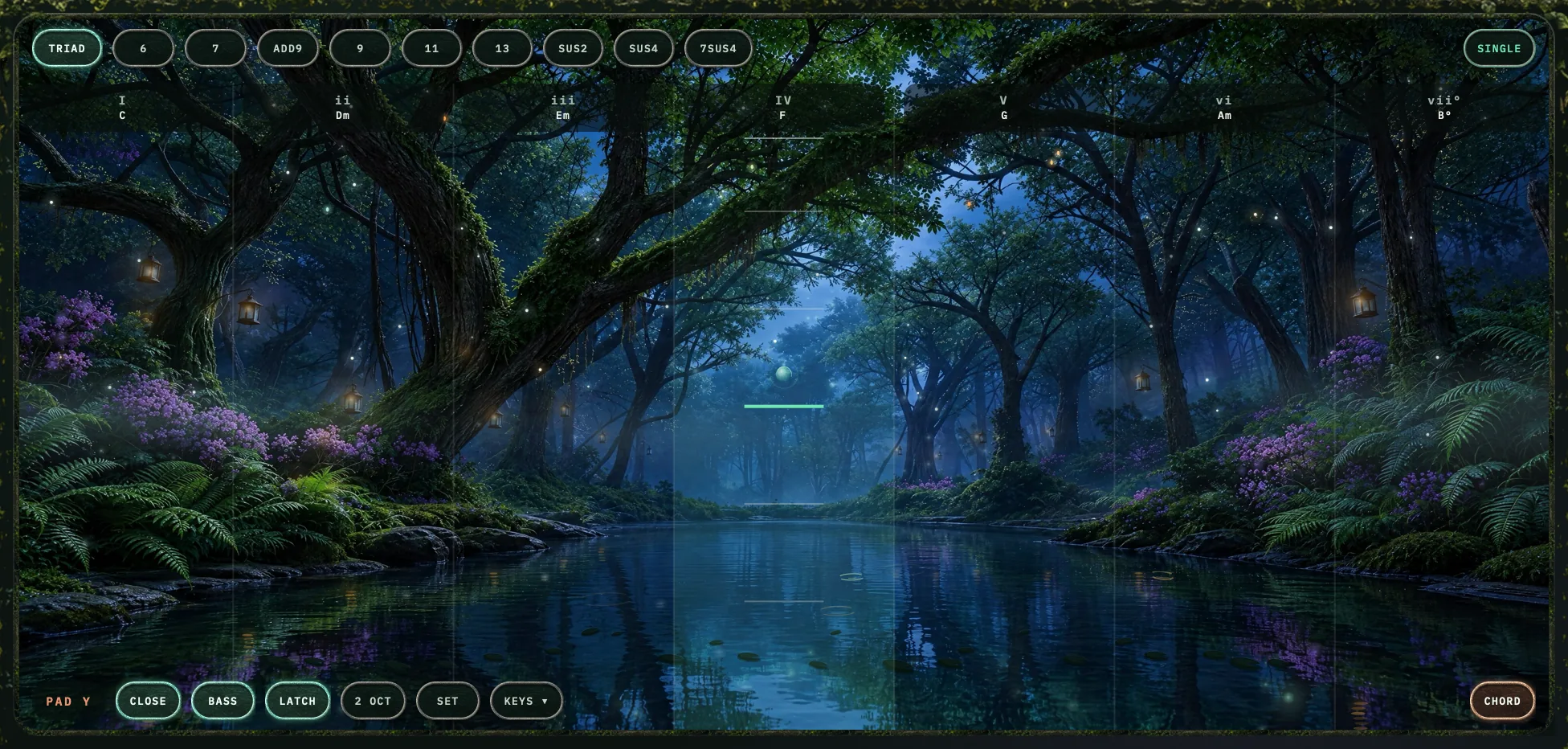
Switch the pond to CHORD and it becomes seven columns, one for each chord in the key. Touch a column and the whole chord sounds; slide up or down and the voicing climbs or falls with your finger, so moving between columns leads smoothly instead of jumping. Ten chord types run along the top, from triads through sevenths, ninths and thirteenths to the suspended ones, with CLOSE, OPEN and WIDE spreads, a root bass note, and LATCH to hold a chord after you let go. SET gives any column a different chord or a different root and adds columns for borrowed chords, so the pad can hold any progression, not only the one the scale hands you. The demo above has the pad, the ten types and LATCH; SET is in the plugin.
-
DUAL PADS
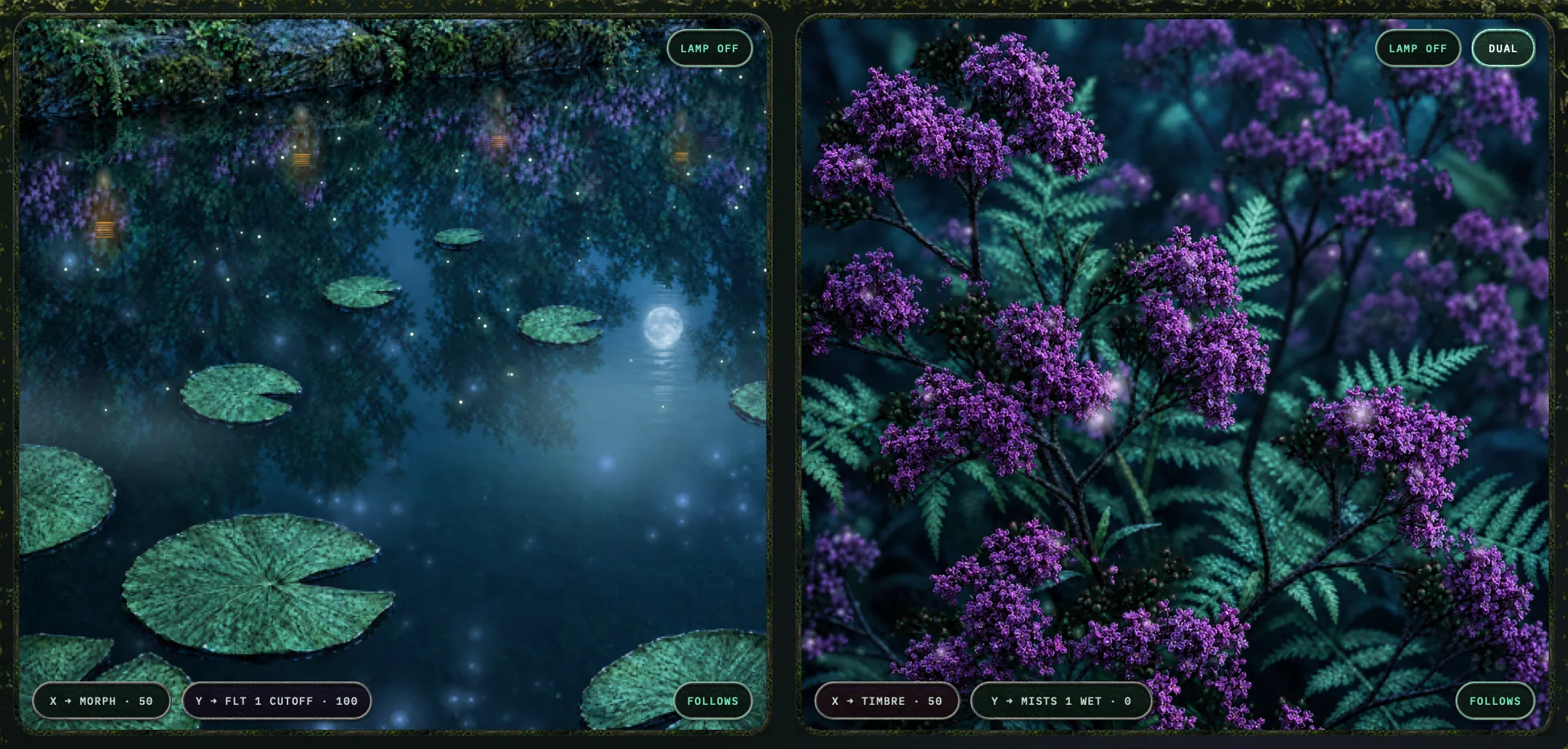
DUAL splits the play surface into two pads side by side: the pond on one, a thicket in blossom on the other. Each has its own X and Y targets, its own pair of matrix sources and its own lamp, which can wander the pad by itself or replay a path you drew. Either pad can stay a modulation surface or become a note or chord pad, so one hand can hold a progression while the other shapes the sound.
- The voice Per-voice, thirty-two times over.
-
ROOTS
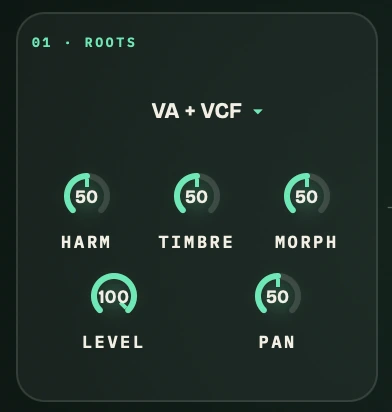
Forty synthesis engines — virtual analog, FM, wavetable, additive, chord, speech, swarm, grain, drums, and twelve newer ports from brass and reed pipe to bytebeat, GENDY and scanned synthesis — including three six-operator FM engines carrying a hundred and twenty-eight classic patches each, where HARMONICS walks the bank and the bubble names the patch under your finger. ROOTS is Mutable's Plaits grown up: harmonics, timbre and morph reshape whichever engine is loaded, and a MACRO knob gives every engine one more law of its own. Every voice starts with two of them: a second oscillator with its own engine, its own harmonics, timbre and morph, and its own level, detune and semitone offset — so a voice can be one engine doubled a fifth up, or two unrelated engines fused into a single note before the resonator ever sees it.
-
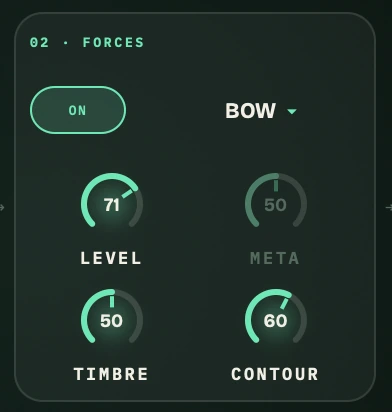
FORCES
An Elements exciter in front of every voice: blow, bow or strike. Blow is granular wind, with a closed pipe inside it that sings at the note; bow is friction noise; strike is mallets and plectra — three ways of putting energy into the resonator. Level, timbre and contour decide how hard it hits and how long it leans in. And SING keeps a note alive for as long as you press: aftertouch or pressure feeds the resonator until it sustains on its own, at the root or a harmonic you choose.
-
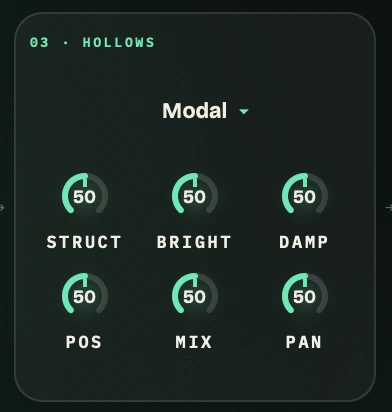
HOLLOWS
Rings, in fifteen models: modal, sympathetic string, string, FM, sympathetic quantized, string with reverb, and nine bodies Rings never had: membrane, plate, drumhead, bell, a fixed shell that stays put while you play across the keyboard, a beating singing bowl, a Helmholtz bottle, a closed-to-open tube, and a sloshing pond. Whatever ROOTS sends it gets a body, and struct, bright, damp and pos move that body from wood to glass to wire, before FILTER and ENV finish shaping the note you just heard.
-
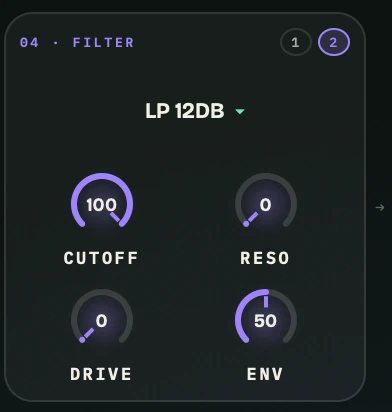
FILTER
Four independent filters per voice, each a full eight-mode set — 12 and 24 dB lowpass, bandpass, highpass, ladder, comb, formant, phaser — with its own cutoff, resonance, drive and envelope amount. SEEDS and SEASONS each pick which slot a line fires through, so two lines in one patch can be shaped completely differently.
-
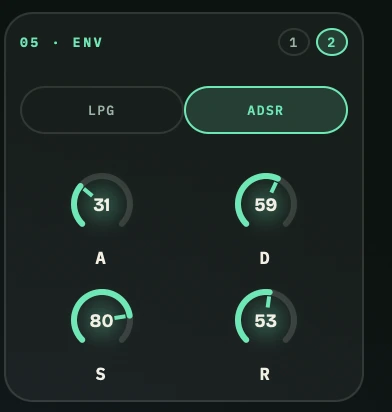
ENV
Four envelopes per voice, each a plain ADSR or Rings' own percussive LPG decay — and in LPG mode, ENV 2 carries its own fall and colour rather than sharing one shape with ENV 1. SEEDS and SEASONS each pick which one a line fires with, so a plucked line and a bowed line can share one patch without stepping on each other's envelope.
- The bus After the voices, before the limiters.
-
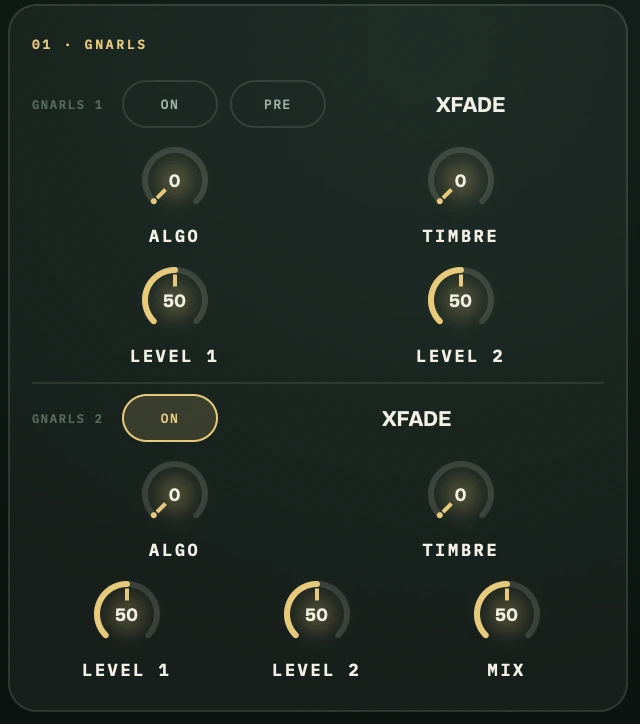
GNARLS
A Warps modulator per voice, cross-modulating the oscillator against the resonator: one continuous knob from wavefolding through ring modulation to a vocoder. A second GNARLS sits on the bus, and it can be wired as a pedal in a parallel loop around the whole effects chain — folding what the effects made, not what went into them. The vocoder can run against an internal carrier at a note you choose, so a voice can be sung through a pitch that was never played. Switch to SHIFT and the same module becomes Warps' frequency shifter instead — moving every partial by the same number of hertz rather than the same ratio, which pulls a note off the harmonic series entirely and, with feedback up, walks it into a barberpole that never stops rising. Beyond WARP, SHIFT and MANGLE, GNARLS now carries Understory's seven Grit models — DRIVE, GLOSS, FUZZ, GROWL, SWELL, OCTAVE and STARVE — so the per-voice slot can be a pedal as easily as a modulator.
-
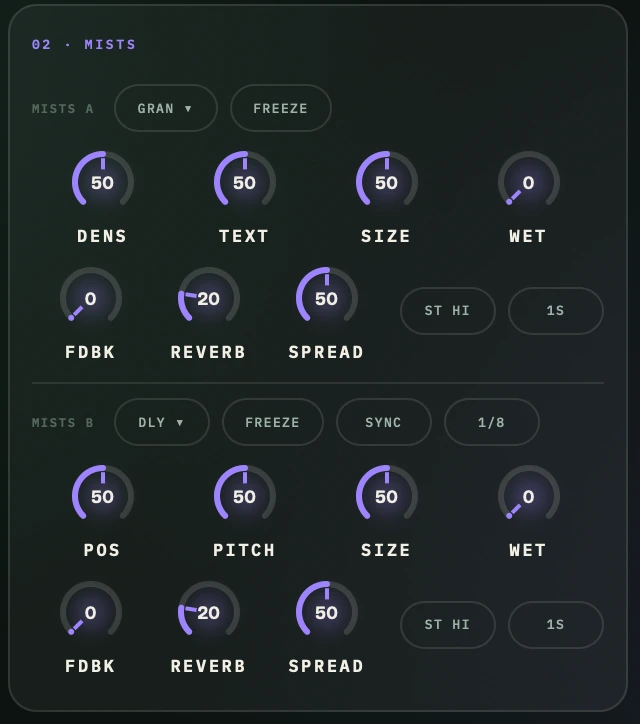
MISTS
Two independent Clouds engines, A and B, each in one of five modes: GRAN granular, STR time-stretch, DLY looping delay, SPEC spectral, and RPT, a tempo-locked beat repeater. Each has its own density, texture, size, pitch, freeze, feedback and reverb. Both lock to host tempo, run at four buffer lengths and four quality tiers, and can sit in parallel or in series with A feeding B. Every source in the synth chooses where it goes: dry, A, B, or both.
-
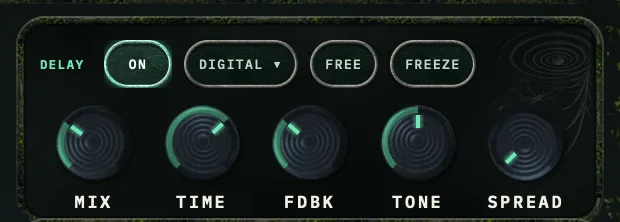
DELAY
A delay across the whole instrument, with five voices behind one set of controls: DIGITAL repeats cleanly, TAPE darkens and wobbles as it feeds back, PINGPONG walks the repeats across the stereo field, and ECHO and WORN — borrowed from Understory — add a warm bucket-brigade line and a tape that has seen better days. Time runs free or locks to tempo at any division, TONE colours the wet signal dark or bright from the first repeat, and FREEZE holds the loop. It runs into the reverb, after it, or beside it — and the pair sits before or after the UNDERSTORY card together. The Night Chorus preset in the demo above runs it.
-
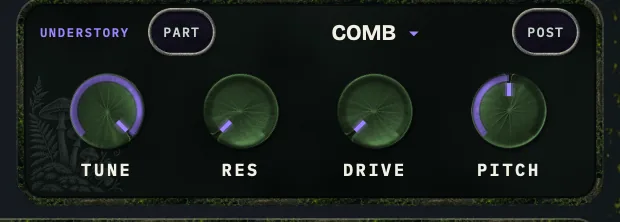
UNDERSTORY
A stereo slot across the whole mix, after the effects and before the limiters, with twenty-five things it can be. Eight filters — 12 and 24 dB lowpass, bandpass, highpass, ladder, comb, formant, phaser — a notch, and sixteen effects lifted from Understory, our effects console: doublers, vibrato, rotary, tape, vinyl, static, press and the rest. One knob each for the thing that matters.
-
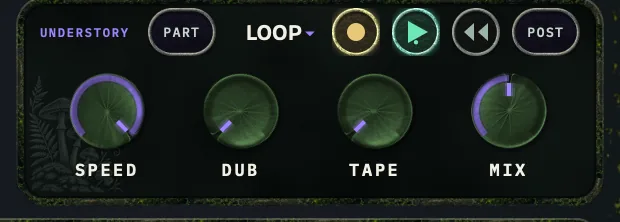
LOOP
The sixteenth UNDERSTORY effect is a tape looper for whatever the instrument is playing. Tap REC to record, again to overdub, and again to play it back; hold it to wipe the tape. PLAY stops and restarts the loop, and holding it takes the last layer off or puts it back. REV runs the loop backwards. SPEED goes from half to double, an octave either way; DUB sets how much of the old layers survives each pass; and TAPE ages the whole thing.
-
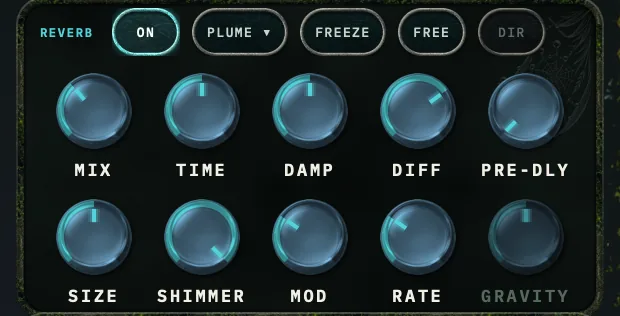
REVERB
A reverb across the whole instrument, with six networks behind one set of controls. ROOM is the Clouds reverb; PLUME is the Parasites Oliverb, which adds size, shimmer and a modulation depth and rate of its own; EVERFALL is a tail that never resolves, with a GRAVITY control that swells it up under your hands or collapses it away, a harmonic layer on the shimmer knob, and a tuned resonance behind the damping knob that makes the tail ring at a note. SPACE, SPRING and GATE come from Understory. Mix, time, damping and diffusion throughout, a pre-delay that can lock to tempo, and FREEZE to hold a tail while everything new is kept out. It sits before or after the UNDERSTORY card, with the DELAY. This is the one thing on this page the demo does not leave out — it is on in every preset above, and Old Growth runs it as EVERFALL. EVERFALL is also our free plugin — the same tail, on its own, in any session.
- Modulation Anything can move anything else.
-
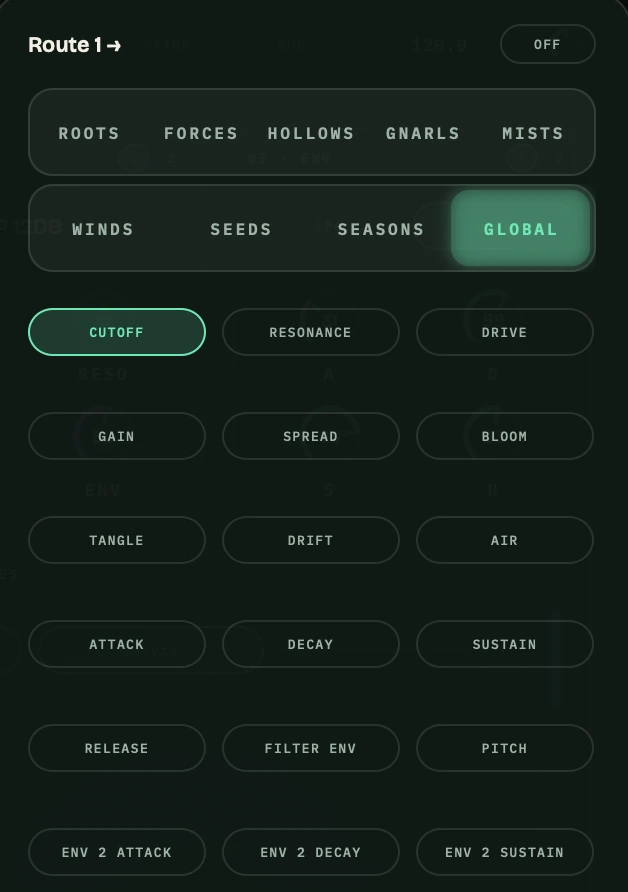
The modulation matrix
Thirty-two routes and twenty-one sources — four LFOs, six SEASONS groups, the X and Y of both GROVE pads, all four envelopes, and the mod wheel, pressure and slide — into 207 destinations covering every module in the synth. An envelope route picks which voices it listens to, so ENV 2 can drive a filter from the bowed layer while the plucked one stays still. Drag a source onto a knob to assign it, and the knob draws its own modulation arc from then on.
-
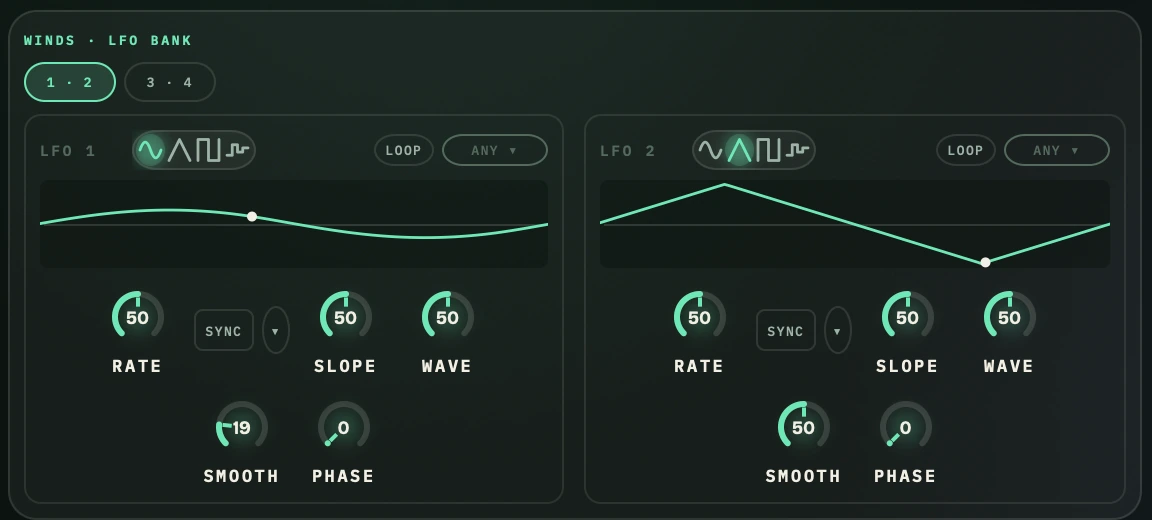
WINDS
Four Tides LFOs, each shaped by the module's own slope, wave, smoothness and phase rather than a fixed list of waveforms. Run them free, sync them to the host, fire them once as an AD or AR envelope, or trigger them from a note. The curve you draw is the curve you get, and it can reach almost anywhere in the matrix.
- It plays itself Generators that make the notes.
-

SEEDS
Marbles' déjà vu core, driving the synth. REVERIE takes a pattern from freely random, through a locked sixteen-step loop, to slowly mutating; THRUM decides how many of those steps actually sound; RUSTLE pushes them early or drags them late without ever dropping one; CANOPY widens the pitch window. Key, scale, rate and octave range keep it musical, and the seed makes any pattern you like reproducible.
That is FLOW, one of three models. DRUMS splits the pattern into two lanes — a low one and a high one, sounding together — so SEEDS builds a kit rather than a line. MARKOV listens to what has already played and chooses what follows from it. LEARN takes it further: play a handful of notes and SEEDS keeps that set as its own scale, so the pattern stays inside the harmony you gave it rather than a preset mode. And when you finally hear a phrase worth keeping, SOW writes exactly what you just heard into SEASONS as editable steps.
-
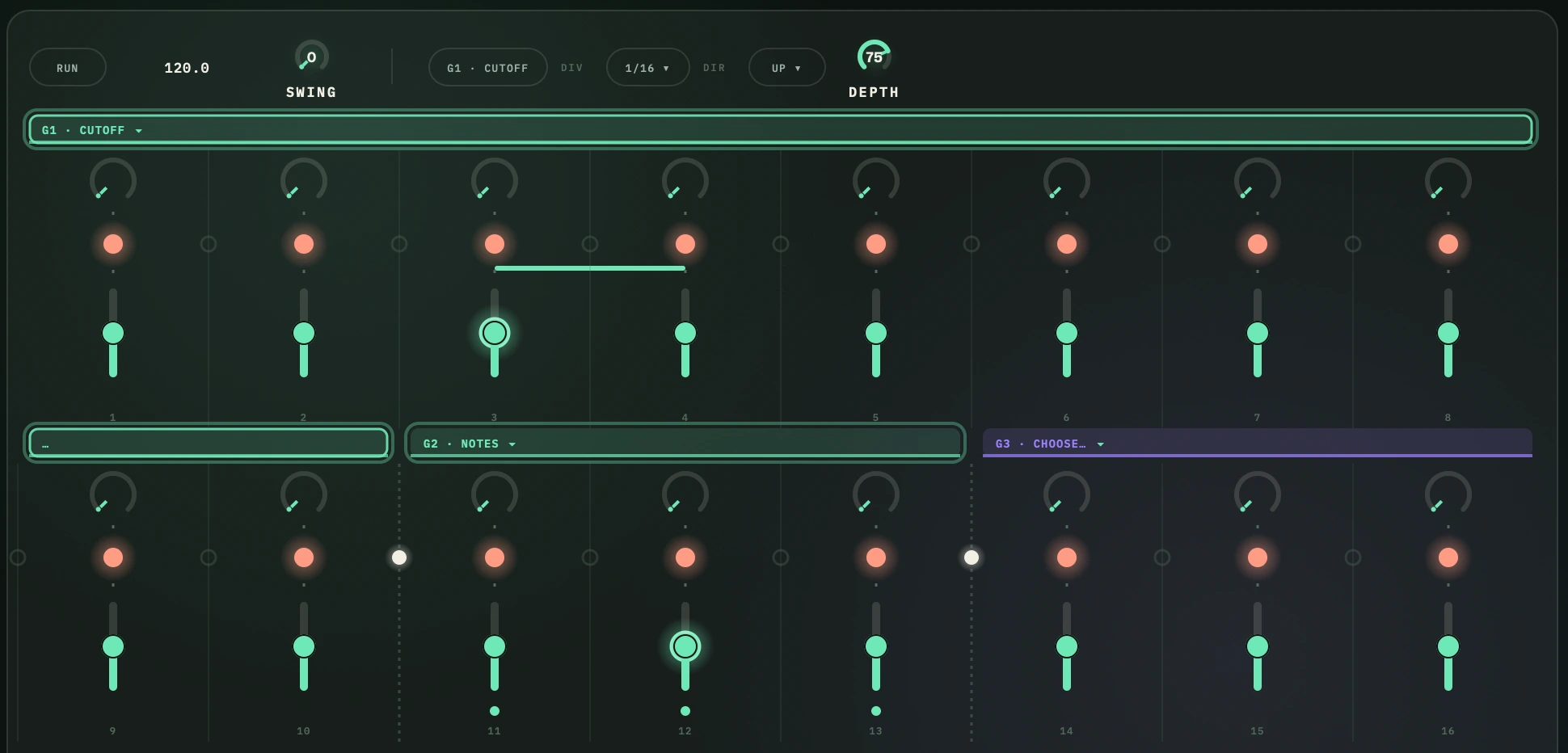
SEASONS
Stages as a sixteen-segment sequencer with up to six independent groups, each running its own division and direction. A group can play notes or modulate any destination in the synth, and every note it plays carries a voice profile — FULL, ROOTS or BREATH — so one line can be the whole instrument and the next can be only its breath.
-
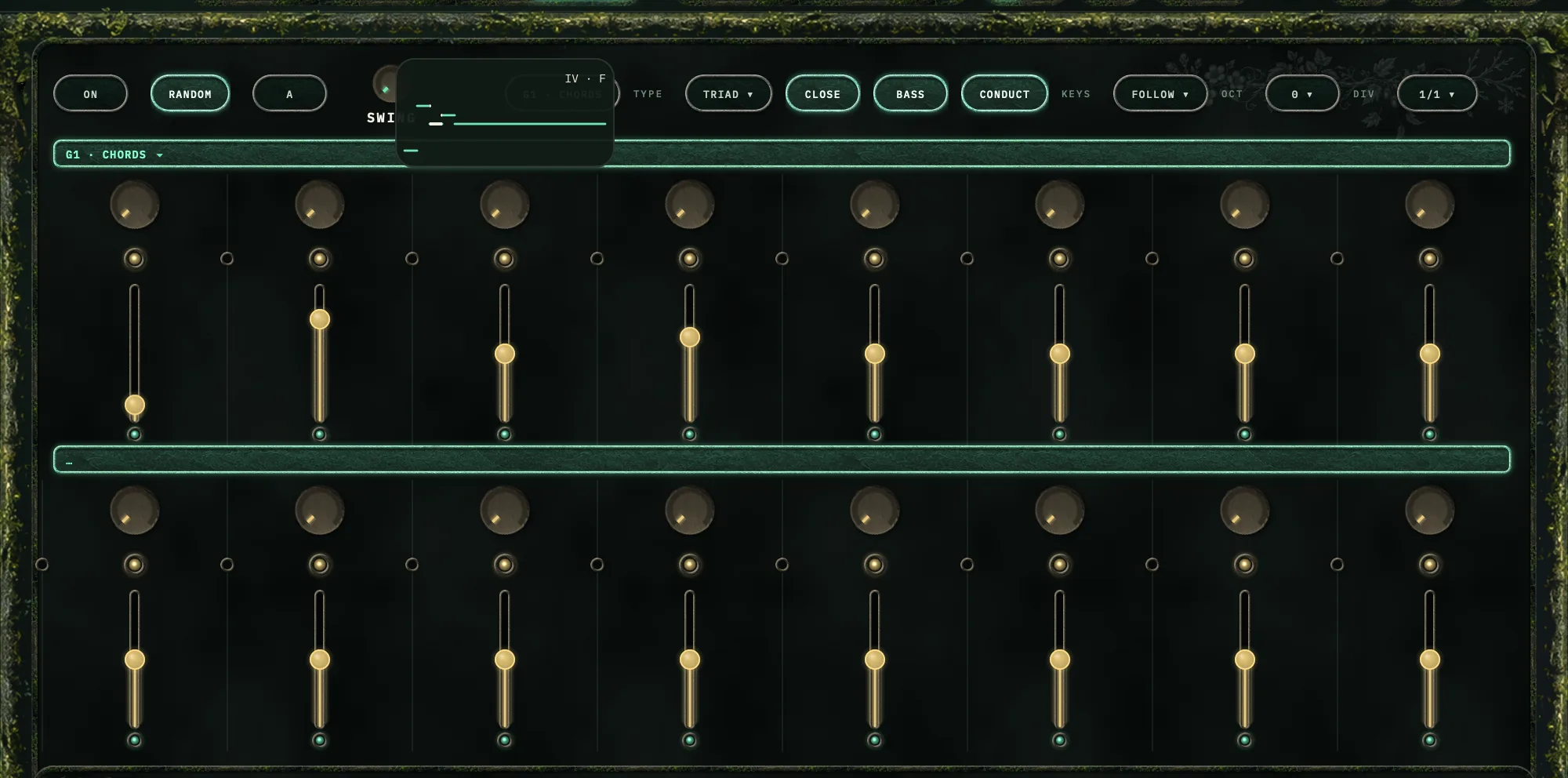
SEASONS CHORDS
Point a SEASONS group at CHORDS and each step plays a chord rather than a note: the fader picks the column, from the same table the chord pad uses, so four steps loop a I–vi–IV–V and your borrowed chords come along. Chords move the way the pad moves them: shared notes keep ringing and only the voices that change step. Turn on CONDUCT and the progression leads the instrument: SEEDS and the other groups follow whichever chord is sounding, and your keys or the pad transpose the whole thing. An automatic left hand.
Four tabs
Inside Sylvaris
Everything above lives inside one plugin window, four tabs deep. This demo only opens GROVE — here is the whole instrument. Tap a screenshot to see it full size.
-
GROVE
The play surface — pond, macros and the SEEDS arp, all in one glance.
-
PATCH
The voice: ROOTS, FORCES, HOLLOWS, FILTER and ENV, plus the matrix routes tying them together.
-
FX
GNARLS, MISTS, DELAY, REVERB and the UNDERSTORY card on the bus, with the routing strip that chains them. The reverb sits before or after UNDERSTORY, so even voices routed dry get a room, and comes in six networks: ROOM, PLUME with its shimmering pitch-lifted tails, EVERFALL, the one that never resolves, and SPACE, SPRING and GATE from Understory.
-
SEASONS
The sixteen-segment sequencer, grouped into up to six independent lines.
Also from Greenlit Audio
Two more from the same forest
-
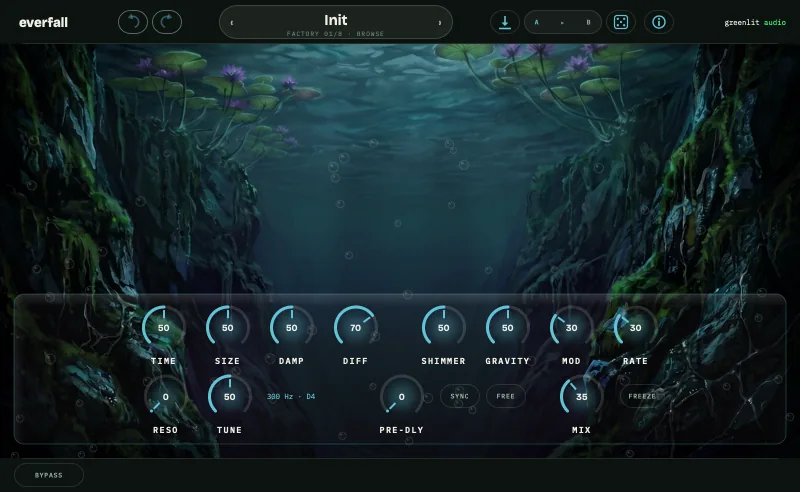
Everfall — free reverb
The tail that never resolves, as its own plugin. Free when it ships.
Get Everfall → -
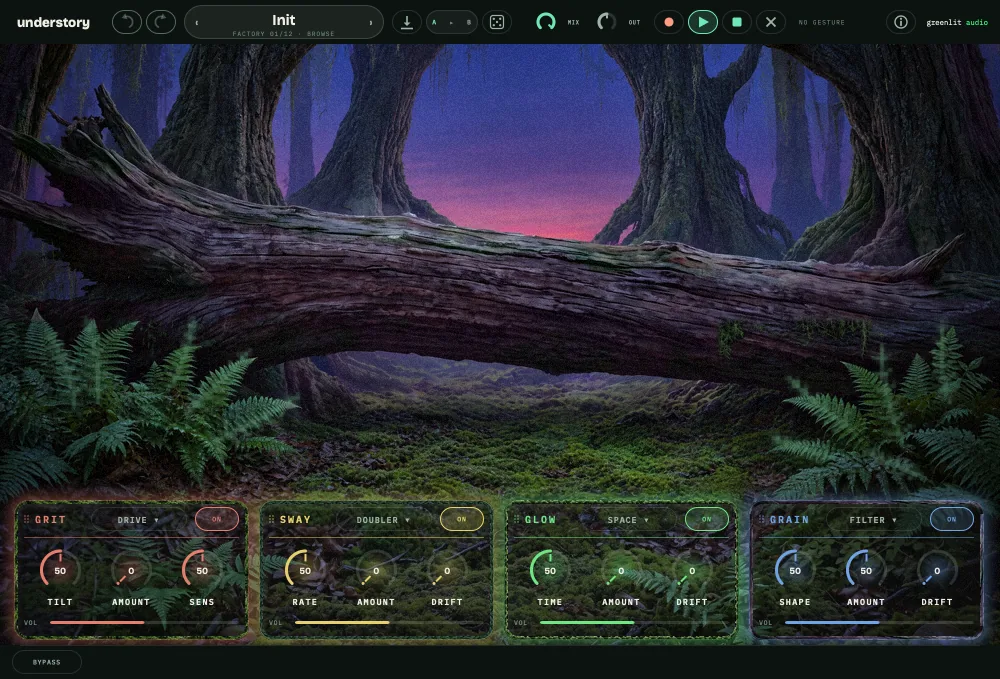
Understory — effects console
Four modules, twenty-eight effects, one knob each for the thing that matters.
See Understory →